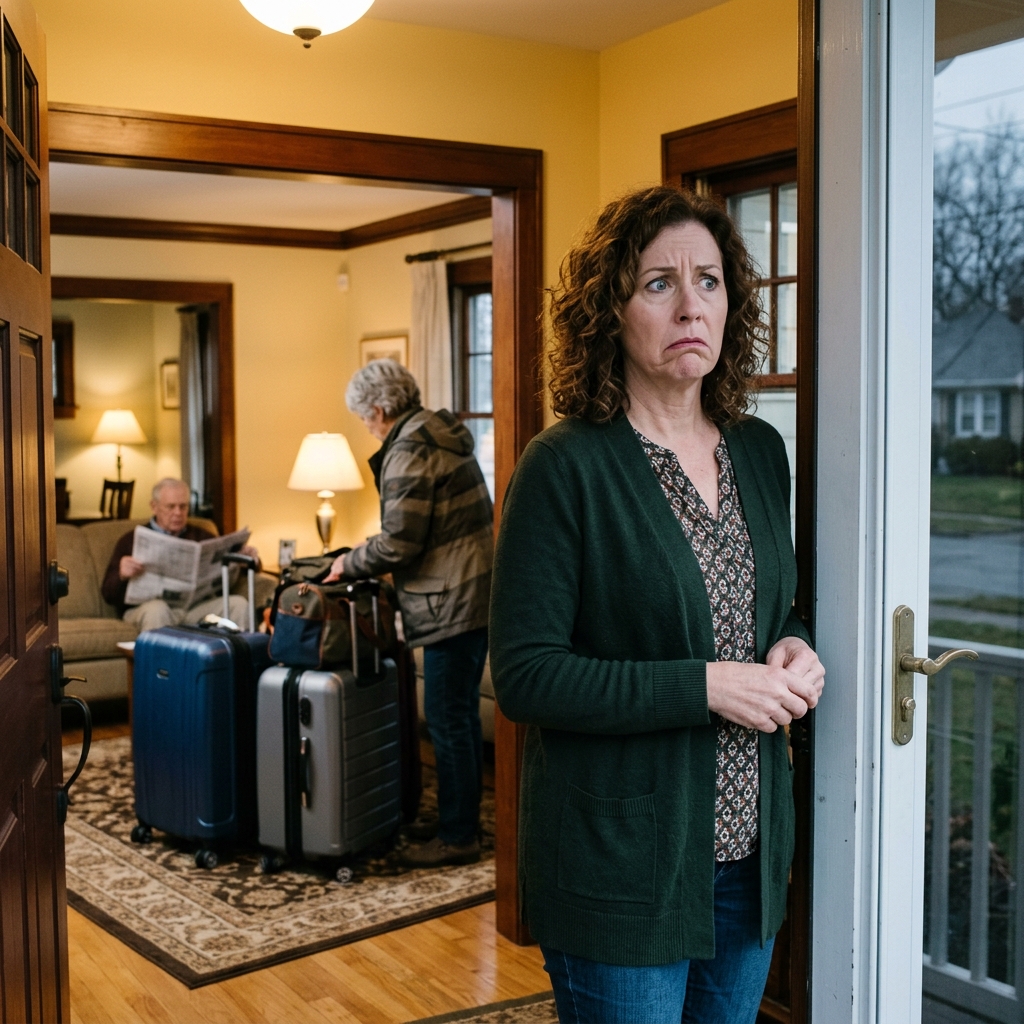
Every neighborhood has one. Ours was Carol.
Carol had lived on our street for twenty-two years. She had opinions about everything within eyeline of her front window: lawn height, mailbox angles, the diameter of holiday wreaths, the number of cars in a driveway on a Tuesday. She had gotten three families before us to move, or so the retired gentleman across the street told me when we first arrived, the way you'd warn someone about a weather system.
I told my wife Jess that we'd be fine. We were reasonable people. We followed the rules. Carol, I assumed, just needed to see that.
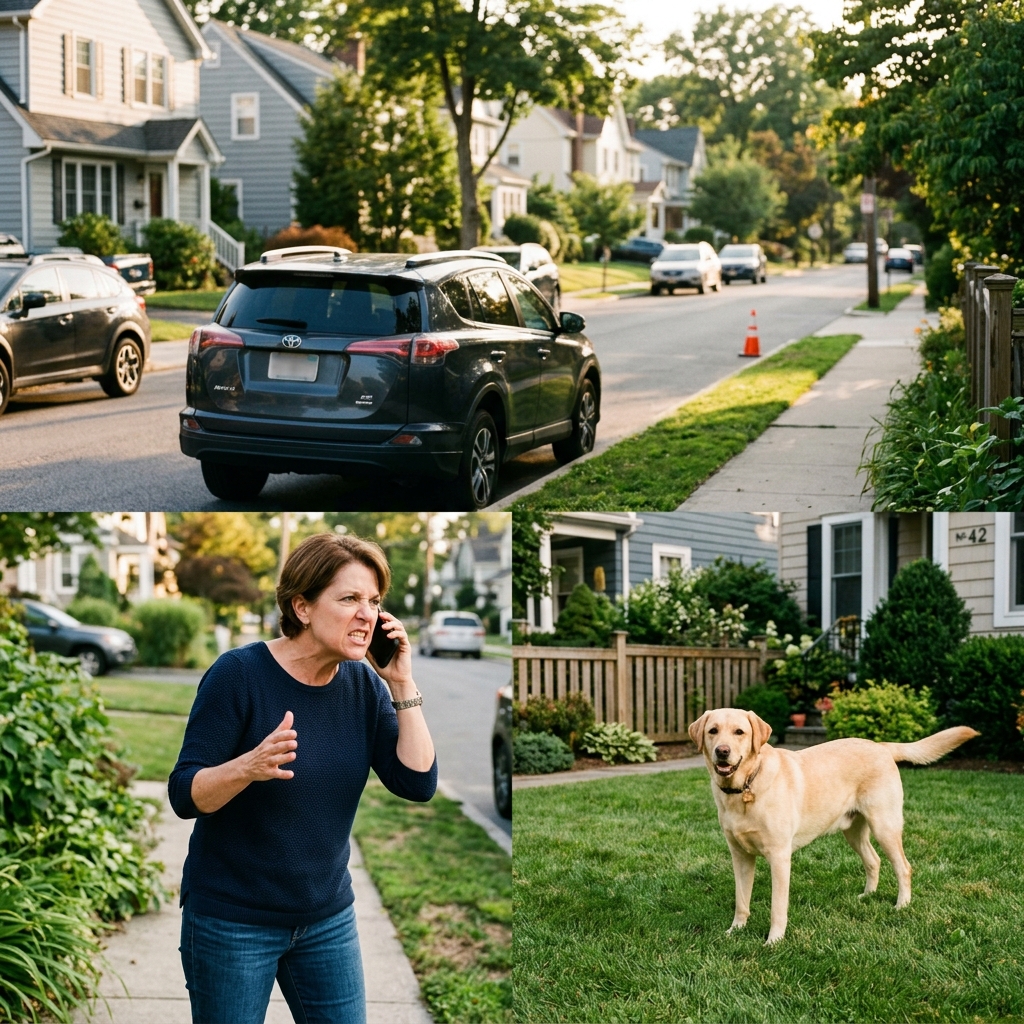
In two years, Carol filed noise complaints about our wind chimes, reported our mailbox height to the HOA, measured — with an actual tape measure, standing in the street in full view of our front window — the length of our lawn, and left seventeen passive-aggressive notes, which I know because I kept them all in a folder labeled, at Jess's suggestion, the “Carol file.” It started as a joke.
Biscuit
Then she called animal control on Biscuit.
Biscuit is a nine-year-old yellow lab. His greatest acts of aggression are: sighing loudly when the mailman doesn't say hi, stealing socks from the laundry basket, and falling asleep in inconvenient locations. He has never growled at a person in nine years. He has never bitten, never lunged, never done anything more threatening than try to climb into the lap of whoever is sitting on our porch.
Carol's complaint alleged an “aggressive, dangerous animal repeatedly menacing the neighborhood.”
The animal control officer came out on a Thursday afternoon. He spent approximately five minutes with Biscuit, during which Biscuit brought him a tennis ball, leaned against his leg, and then fell asleep on his shoes. The officer closed the case. He was barely able to keep a straight face when he left.
But it went on a record. A file existed now with my dog's name in it, and a second complaint — regardless of merit — would not start from zero. That is how these systems work. Carol knew this. I believe she knew this specifically and deliberately.
Playing By the Rules — Her Rules
I want to be clear about what I did not do. No vandalism. No late-night nonsense. No escalation that would make me the villain of someone else's story, or give Carol anything she could use as evidence of her own persecution. I have been a homeowner long enough to know that in HOA disputes, temperament matters as much as facts.
What I did was much simpler: I read the HOA handbook.
All sixty-three pages. Twice. Once quickly, once with a highlighter.
It turns out that when a person weaponizes the rulebook for two years, they very rarely stop to check their own compliance. They are too busy watching everyone else.
The unpermitted storage shed Carol had built against the shared fence line: not approved by architectural review, as required by section 4.7. The RV parked in her driveway: the handbook allows a maximum fourteen-day parking period per calendar year for recreational vehicles; Carol's had been there eleven months. The six trash cans visible from the street: three over the limit. The “decorative pond” she'd dug in her side yard without the drainage review that the handbook explicitly requires for any excavation over six inches — the same pond, I'll note, that hosted the mosquito population of a small rainforest every summer and about which Jess had complained to me bitterly for two years.
I documented everything from my own property and the public street: dates, photographs, section citations. I composed the complaint letter carefully, formally, citing chapter and verse. I described myself, in the opening paragraph, as “a neighbor committed to the consistent application of community standards.”
That phrase was from one of Carol's notes. The one about the wind chimes.
The HOA Process
The HOA, faced with a documented complaint file thicker than anything Carol had ever produced, did what HOAs do: they sent enforcement letters, set remediation deadlines, and issued fines for non-compliance with those deadlines.
The shed came down in October. It took three weekends and what I can only describe as a deeply satisfying amount of effort on Carol's part.
The RV moved to a storage facility the following week. The pond got its drainage review, which it failed — not dramatically, not dangerously, just in the quiet, bureaucratic way that means more paperwork, more inspections, more fees.
I never spoke to Carol about any of it. She never spoke to me. We communicated entirely through the HOA's formal channels, which is precisely how she had always preferred to operate, and which I had finally decided was fine by me.
The Quiet After
And then something remarkable happened: silence. No more notes. No more tape measures in the street. No more complaints to any agency about anything. Carol and I have not exchanged a single word in over a year.
Our street has never been more peaceful.
Biscuit remains at large, menacing the neighborhood with his tennis ball. The animal control file sits wherever those files sit, quietly gathering no additions. The wind chimes are still up. I may add a second set.
I'm not saying it was the mature path. There is a version of this story where I took the high road, continued to absorb the complaints with grace, and modeled the kind of patient civility I'd want my children to see. That version exists. I admire it from a distance.
What I am saying is this: some people only respect the rules when the rules finally look back at them. And that everyone — absolutely everyone — should read the handbook before they start quoting it over a fence.