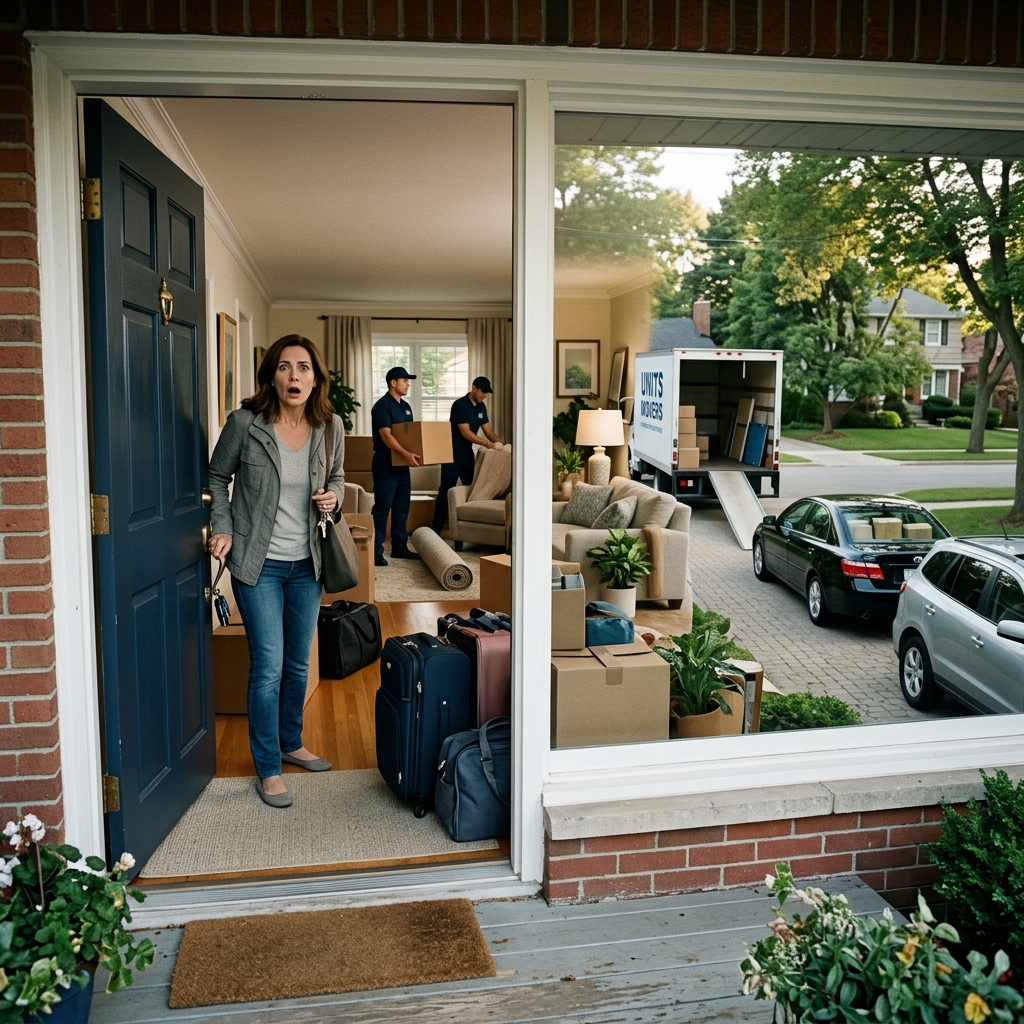
The first sign was the car in the driveway. It was parked where we usually park, angled slightly off-center the way only a familiar person parks — someone who thinks of the driveway as partly theirs. I thought, for a confused moment, that we had the wrong block.
The second sign was the doormat. Our doormat — a plain gray rectangle that said nothing in particular — was gone. In its place was a new one, terracotta-colored, with flowers on it, that said: Welcome to Grandma's.
I stood on my own front porch with a suitcase in each hand, ten days of Florida sun on my shoulders, and genuinely wondered if I was losing my mind.
We were not at the wrong house. My mother-in-law, Diane, had moved in. While we were on vacation. Without telling either of us that she was going to.
How It Happened
Diane had a key for emergencies. We'd given it to her two years earlier after a plumbing situation when we were stuck in traffic on the highway and needed someone who could let the repairman in. It had worked exactly once. We'd never thought twice about it.
What we hadn't known — and what she hadn't told us, not over Thanksgiving, not at Christmas, not during any of the phone calls between then and our Florida trip — was that Diane had been fighting with her landlord for four months over a lease renewal. Rent had been raised. Negotiations had broken down. And Diane had decided, at some point between the breakdown of negotiations and the moment our plane landed, that the obvious solution was our guest room.
She'd hired movers while we were in Florida. Our home office — where my husband Dave runs his freelance consulting business — was now stacked floor-to-ceiling with her boxes. Her clothing filled the closet we'd been using for off-season storage. Her food had displaced ours in the refrigerator, organized by category with neat labels. Our throw pillows had been rearranged. A cross-stitch that she liked but we'd never hung was now above the hallway console.
She had changed the doormat.
The First Conversation
Dave went pale. He is not a pale man by nature. He went pale in the way that means something is registering as a very large problem, and he is currently fighting every instinct to minimize it.
His first words to her were: “Mom. This is not okay.”
I credit him for that. I know how hard those words were for him to say, standing in our own entryway, looking at the cross-stitch on the wall.
Diane's response was immediate and well-rehearsed, the way responses are when they've been prepared in anticipation of objection: “You have three bedrooms and I raised you. Family doesn't need an invitation.”
I wanted to say at least eight things. I didn't say any of them. Instead, I said I needed some air, went for a very long walk around the neighborhood, sat on a bench by the pond for forty-five minutes, and returned having decided on a single rule: I would not fight with Diane. Not because she hadn't earned a fight — she absolutely had — but because fighting with Diane was Dave's responsibility, and taking it from him would only make things worse in ways that would last longer than this crisis.
The Terms
That night, after Diane had gone to bed, Dave and I sat at our kitchen table and worked out the terms before we said a single word to her.
She could stay thirty days. That was the outside limit, not a negotiating position. We would help her find an apartment — actively, not just by sending links. Rent would be zero. But the deadline was real, and the key would come back at the end of thirty days regardless of whether she had found a place.
We also agreed that Dave would deliver these terms alone, without me in the room, because Diane needed to understand that this was her son drawing a boundary, not her daughter-in-law.
Dave told her the next morning. Diane cried. She said we were throwing her to the wolves. She said she hadn't raised her son to be this way. She called Dave's sister Pam, apparently expecting backup.
Pam, bless her, said: "Mom, you moved into their house while they were on vacation. That's not normal behavior."
That was the first moment I felt like we might actually survive this.
The Thirty Days
The thirty days were not comfortable. Diane was polite in the specific way that communicates deep grievance — very quiet, very careful, every gesture slightly too small. She was not unpleasant. She was broadcasting unpleasantness while technically behaving.
We found her an apartment on day twelve. A lovely one-bedroom in a complex fifteen minutes away, with a balcony and an elevator and a gym she would never use. We toured it together, and she said it was fine, in the tone people use when they mean it's insufficient.
Day twenty-six, Dave and I borrowed a truck and helped her move. She was moved in by evening. I took the doormat off the porch and put ours back.
What Came After
Diane sulked for about a month. Her calls to Dave were shorter than usual, more formal. The first Sunday dinner invitation was declined with a headache that I did not believe was real.
And then, slowly, something surprising happened.
Our relationship got better.
Not immediately, not dramatically — but incrementally, visit by visit. Sunday dinners became something she looked forward to rather than took for granted. She started calling before she came over. She knocked. She asked if we were free before proposing a day.
I think having her own space made her value ours. Or perhaps the boundary itself communicated something she needed to hear: that she was a guest in our lives, a welcome and loved guest, but a guest — not a resident, not a co-owner, not someone whose presence required no negotiation.
People ask if I overreacted. I ask them what they'd do if they came home to a stranger's doormat on their own front porch.
A boundary isn't a punishment. It's not cruelty or rejection. It's the condition under which relationship is actually possible — and the reason, two years later, that I genuinely enjoy Sunday dinners with my mother-in-law.