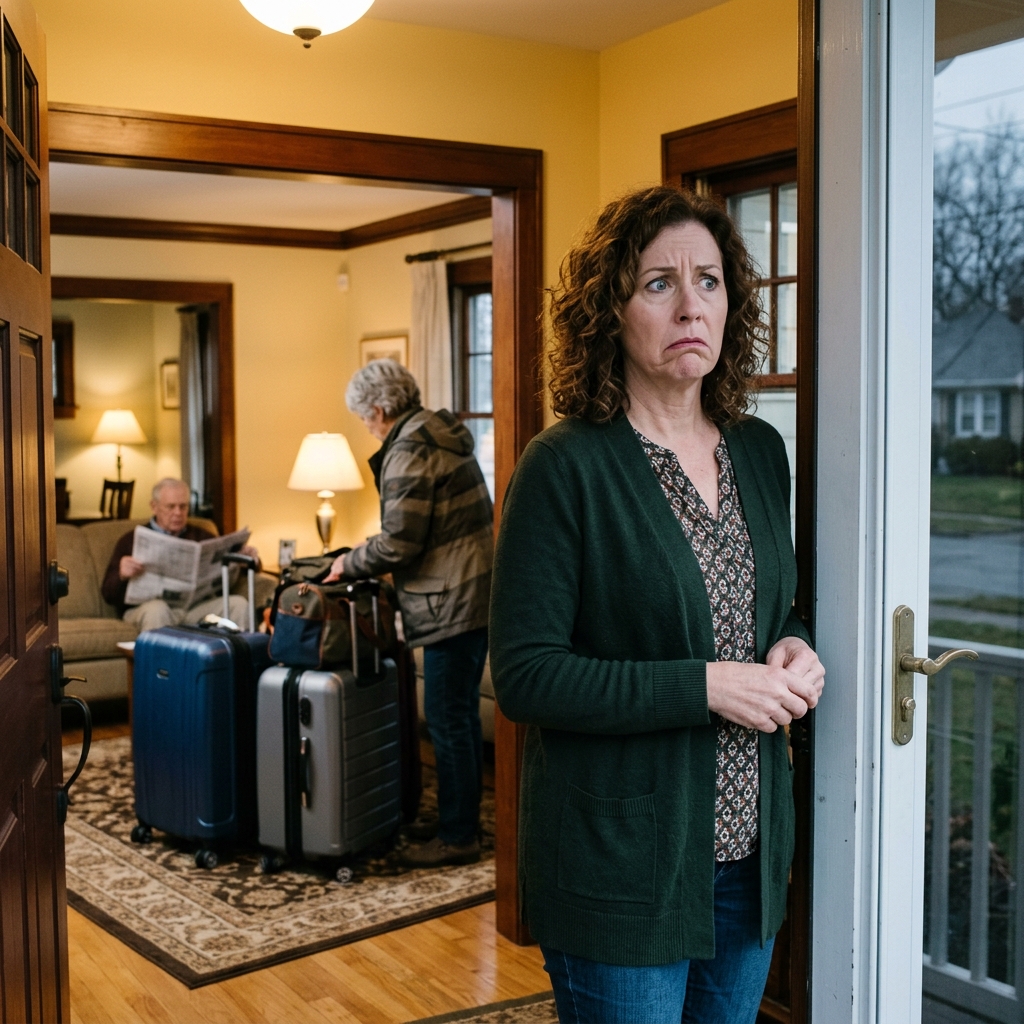
Everyone has that one in-law who makes you feel like you're being graded. Mine was Eleanor.
Silver hair always set, never a strand out of place. Thank-you notes mailed within forty-eight hours, written by hand on cream-colored stationery with her initials at the top. Her dining table was laid properly at every meal, not just at the holidays — placemats, cloth napkins folded into birds or fans, a small vase with something seasonal in it. The woman had standards the way some people have religion: total, quiet, non-negotiable.
For ten years I loved her and felt slightly inadequate around her in equal measure. My house looked like people lived in it. Eleanor's looked like it had been photographed for something. When I hosted Thanksgiving, I borrowed napkins from a friend rather than let Eleanor see that mine were paper.
Under the Guest Bed
Last Thanksgiving, we stayed at Eleanor's for four days. On the third night, I couldn't sleep. The duvet in the guest room was too warm, and there was an extra blanket somewhere — I'd seen one earlier in the week but couldn't remember where.
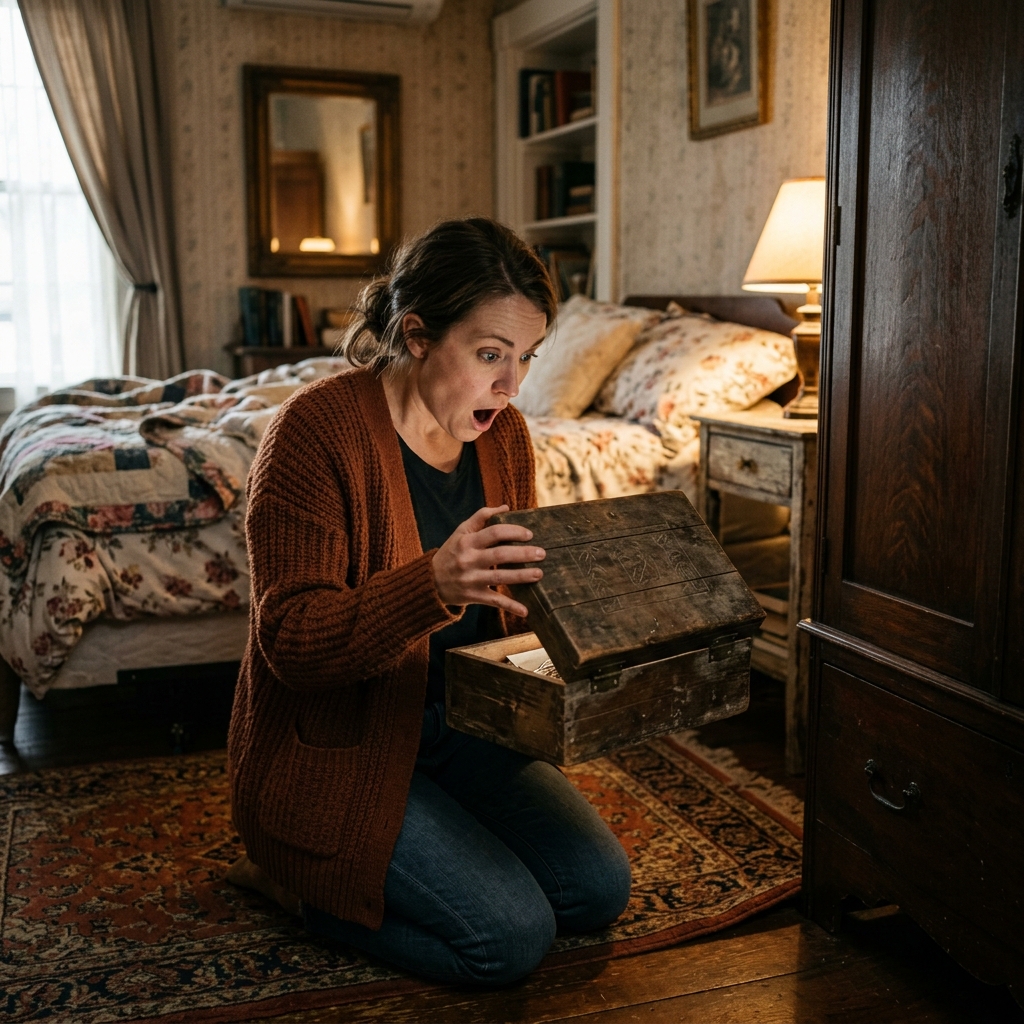
I checked the closet. I checked the cedar chest at the foot of the bed. And then I knelt and looked under the guest bed, the way you always look last in the place you'd least expect it, and that's where I saw the box.
It was large, plastic, the kind meant for winter clothes or seasonal decorations. It was pushed deep against the wall, but it hadn't been pushed all the way — the lid sat slightly crooked, and in the gap between the lid and the box I could see the edge of a spiral notebook.
I want to say I didn't look. I looked.
What Was in the Box
Notebooks. Dozens of them, spiral-bound, dated on their covers in her perfect handwriting, going back more than forty years. 1983. 1979. 1972. I could see the dates without pulling them out.
And on top of the notebooks, a photograph. Eight inches by ten, black and white, slightly faded at the edges. A house I didn't recognize: a leaning porch, a dirt yard, a hand-pump water spigot, paint peeling from the siding in long curling strips. Seven children lined up in front of the house in clothes that clearly didn't fit — too big on some, too small on others, the particular ill-fit of hand-me-downs through a large family.
On the back of the photograph, in pencil, in a younger version of Eleanor's handwriting: "Home, 1961."
The girl on the far right of the photograph was barefoot, holding a baby on her hip, squinting into the sun. She was maybe eleven. I recognized her immediately, across sixty years: the set of her jaw, the straight posture even in bare feet on a dirt yard, the particular quality of dignity she was already carrying.
It was unmistakably Eleanor.
I sat on the edge of the guest bed for a long moment.
Then I opened one notebook. I've made peace with that trespass. I read exactly one page — not because I have a right to, but because I am human and I am flawed and the notebook was open.
It was dated 1987. It said, in Eleanor's handwriting: "Bought the good napkins today. Real linen. Nobody at that table will ever know what a dirt floor feels like. That is the entire point of me."
I closed the notebook. I put the photograph back in the box. I slid the box exactly as far back under the bed as it had been. I didn't find the blanket. I lay on top of the duvet and I didn't sleep at all.
The Conversation
At breakfast the next morning, I was quieter than usual. I don't know what showed on my face — something, apparently. Eleanor poured coffee and looked at me across the table for a moment, and then she looked toward the hallway that led to the guest room, and then she looked back at me.
She said: "You found my box."
It was not a question.
I said I was looking for a blanket. She said she knew. She sat down. She wrapped both hands around her coffee mug in a way I'd never seen her hold anything — not poised, just holding it.
What followed was the longest conversation we've ever had. She told me about the seven children and the father who drank the farm away, piece by piece, over fifteen years. She told me about the teachers who sent her home with food wrapped in newspaper so the other children in the lunch line wouldn't see. She told me about leaving at seventeen with thirty dollars and a suitcase, about the jobs that weren't jobs and the places that weren't safe, and about the moment she decided — the specific Tuesday in 1969, she remembered the day — that she was going to build a life that didn't look like the one she'd come from, brick by brick, napkin by napkin, standard by standard.
She built Eleanor of the good napkins from the ground up, starting at nineteen, and she had never — not once, not even to her own son, my husband — spoken of the girl in the photograph.
"It's not shame anymore," she said. "I made my peace with that girl a long time ago. It's just a room I keep closed. But I write everything down, because pretending it never happened felt like abandoning her. Somebody should remember her. Even if it's only me."
After That Morning
I don't feel graded at Eleanor's table anymore.
When she sets out the good napkins now, I know exactly what they mean. Not perfection. Not judgment. Distance traveled. Every carefully folded square of linen is a measurement: this far from where I started.
She's never brought it up again, and I've never asked. We've both, I think, understood that the conversation was complete — that it said what needed saying, and that the rest belongs to her.
Last month, for my birthday, she gave me a small wrapped box. Inside was a spiral notebook, new, with my name on the cover label in her handwriting. And a note, on her cream-colored initialed stationery:
"Start writing things down. Someday some girl will need to know what you survived, too."
I've written three pages so far. I'm going to keep going.