It was the week after I lost my job. I don't want to make this into a longer story than it is — the company had layoffs, my department was eliminated, I had $22 in my checking account and a rent payment due in eleven days. I had been to the food bank once before, in college, and I'd told myself I'd never need to go again, which is the kind of thing you tell yourself when you're young and haven't yet learned that circumstances don't negotiate with your pride.
Instead of the food bank, I went to the grocery store. I'd done the math on $22 the night before. I knew exactly what I was buying.
There is a particular kind of mental arithmetic you do in a grocery store when you have $22 to your name. Milk, yes. Eggs, yes — protein, important. The good bread, no — store brand. Cheese back on the shelf; I'd thought maybe a block of sharp cheddar, but cheese is a luxury. Apples out, bananas in, the math on bananas is better. By the time I got to the register I'd made sixteen of these decisions, and I laid the items on the conveyor belt and kept a running total in my head.
I was $4.30 over. I'd miscalculated the chicken.
“Just take the cheese off,” I told the cashier quietly. “And the chicken.”
He started scanning things back. The line behind me had three people in it. I could feel the heat in my face spreading up to my hairline.
The Woman Behind Me
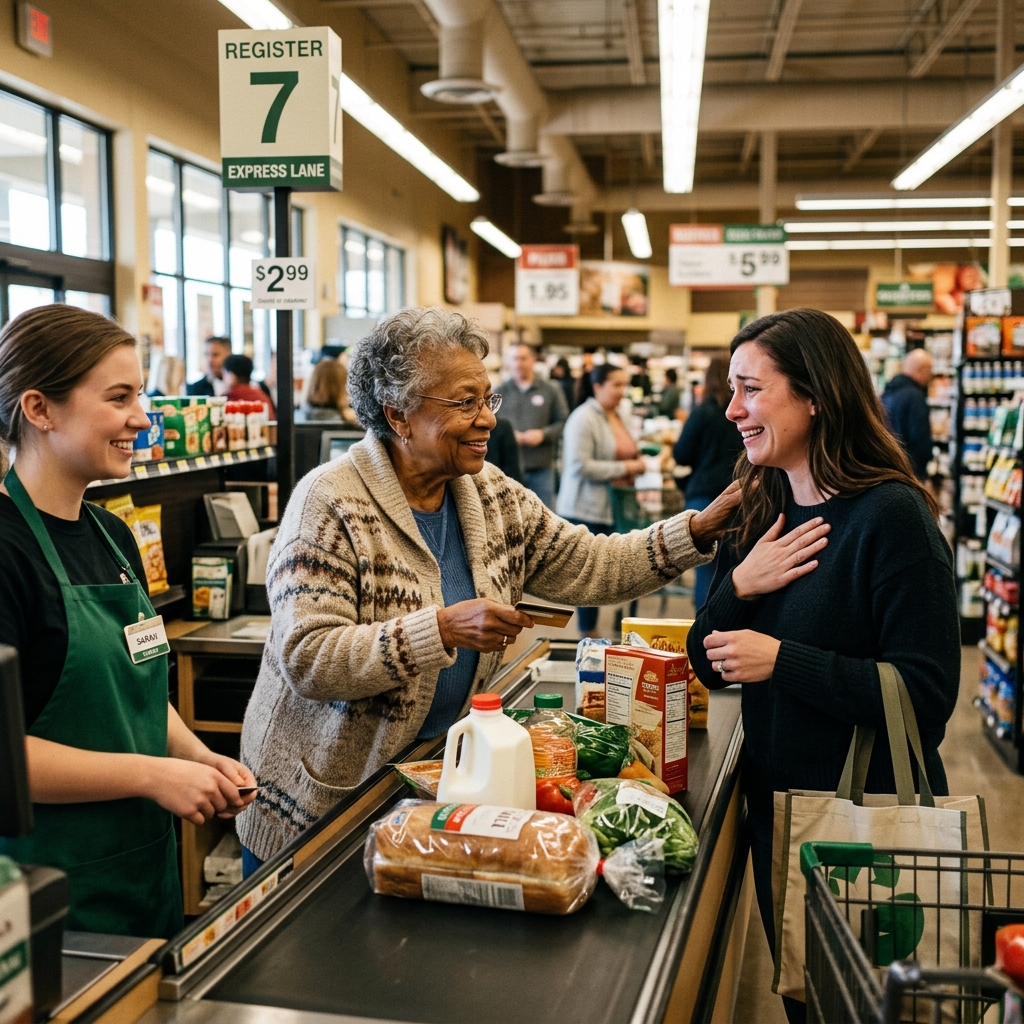
The woman behind me was maybe sixty. She had silver hair cut close and a rain jacket in that practical green that means she buys things for function, not fashion. Her cart was full of ordinary things — yogurt, a rotisserie chicken, three kinds of fruit. She looked like someone's reliable aunt, the kind who remembers birthdays and always has the right tool for any home repair.
She didn't make a scene. She didn't announce anything. She just touched my elbow, lightly, the way you'd touch someone's arm to get their attention in a crowded room, and said: "Put it all back on, sweetheart."
Then she handed her card to the cashier before I could say a single word.
I tried. I said no. I said please. I think I said something about how I'd be fine — which was not true, but it's the thing you say. She just shook her head, very slightly, like I'd offered to pay her for the weather. A transaction that was simply not available.
The cashier, to his credit, understood immediately. He processed everything. He didn't look at me the way I'd feared people would look at me. He handed me my bags and said “have a good one” in the exact same tone he said it to everyone.
The Note
While the receipt was printing, the woman scribbled something on the back of her grocery list. She folded it in half and pressed it into my hand without ceremony, the way you'd return someone's dropped wallet. Then she put her own items on the conveyor belt and started paying for her own groceries, and that was that.
I walked to the parking lot with my bags. I sat in my car. I unfolded the note.
In neat, slightly hurried handwriting, it said:
"Someone did this for me in 1989 when I had two babies and no husband. I've been paying it back ever since. Don't pay me back. Pass it on when it's your turn. — M."
I sat in that parking lot and cried for a solid ten minutes. And then I sat for another five minutes and tried to understand what I was actually crying about. It wasn't gratitude, exactly, though I was grateful. It wasn't even relief, though I felt that too.
I think it was this: I had been walking around for a week feeling like a person who had become invisible, whose problems were too embarrassing to share and too small to matter. And a stranger in a green rain jacket had looked directly at me — had seen me, specifically, in the middle of my specific shame — and had done something about it without making me feel like a charity case. Without making me feel like anything except a person who needed something and was getting it.
That's harder to do than it sounds. Most kindness comes with a cost to the recipient's dignity. Hers didn't. I've thought about that a lot in the years since.
My Turn
I found work that fall. Not the same kind of work, but work — a contract position that became full-time, a salary that left room to breathe. Life mended, the way it does, incrementally and without fanfare. I kept M.'s note in my wallet for two years, folded along its original creases, until the paper softened from handling.
Two years later, almost exactly, I was in a different grocery store in a different city. I was in line behind a young man — early twenties, maybe, construction boots, a sleeping toddler in the cart seat — who was counting dimes and quarters for a box of diapers and a can of formula. Doing the same shameful math I knew by heart.
I watched him ask the cashier to put back the formula. The cashier started to reach for it.
I touched his elbow. I said: “Put it all back on.”
He looked at me the way I had looked at M. — embarrassed, grateful, unsure whether to accept it. I shook my head the same way she had shaken hers. The cashier understood immediately, the way cashiers always do.
While the receipt printed, I wrote on the back of my own receipt: "Someone did this for me. Pass it on when it's your turn."
I didn't sign it. I don't know why M. signed hers, but I liked that she did. I think I didn't sign mine because I wanted it to feel like it came from everywhere and nowhere, from the long chain of strangers rather than from me specifically. I wanted him to feel what I'd felt — not that one kind person had helped him, but that the world was slightly kinder than he'd thought it was.
M., if you ever read this: it was my turn. I passed it on. I suspect it's going to outlive us both.