My father left when I was eight. Not dramatically — no shouting, no slammed doors. He just became less and less present until one day his side of the closet was empty and the absence was total. After that, birthdays came and went. No calls. No cards. No explanation. My mother never said a bad word about him, which somehow made it worse — like she was protecting me from something I deserved to know.
By the time I was in college, I had stopped expecting anything. By the time I got engaged, I had stopped thinking about him at all — or so I told myself. Claire could tell me I was lying. She usually could.
The Invitation I Almost Didn't Send
It was Claire who convinced me to send him an invitation. I had been going back and forth for weeks — not because I wanted him there, but because I couldn't figure out who I wanted him to be. An absent father. A villain. Someone with a reason.
"Not for him," she said, one morning over coffee. "For you. So you never have to wonder." She said it simply, without drama, the way she said most things that mattered. I mailed the invitation to his last known address that afternoon, and I told myself it would come back undeliverable. That would be its own kind of closure.
It didn't come back. I never thought about what would happen if it didn't come back.
He Was Already There
He arrived twenty minutes before the ceremony. I didn't notice him at first — Claire saw him and squeezed my hand and said, quietly, "There's a man at the back of the church in a new suit." I looked, and it took me a moment, because the person I saw was smaller than the one I remembered. Shorter. Older in a way that twenty-two years will do to a person. He was holding a shoebox under one arm like it might fly away.
I walked over ready to be cold. I had spent twenty years preparing to be cold. I knew exactly what I would say — measured, controlled, something that made it clear I had built a full life without him and would continue to do so. I had practiced it.
What I actually said was: "You came."
He looked at me for a long moment. His eyes were doing something I didn't know how to look at. Then he said, "I've come every year. I just never made it past the mailbox."
Twenty Letters
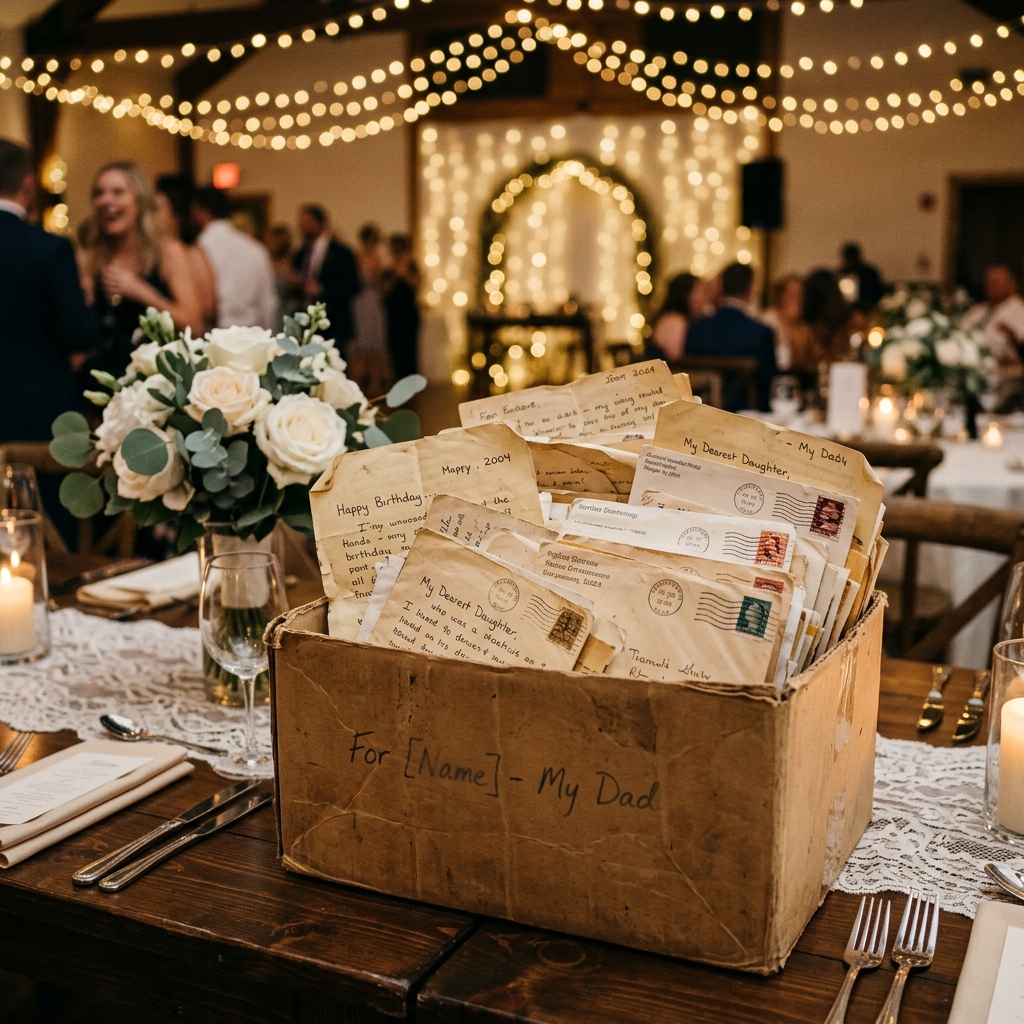
Inside the box were twenty envelopes. One for every birthday he had missed. Each one sealed, dated, and never sent — with my name written in handwriting I recognized as his from the only card he'd ever given me, a drawing of a dog I'd asked for at age six before everything changed.
He told me he had written them during his first year of recovery, and every year after. His sponsor had told him to write, that he didn't have to send them yet, but that he had to write — that it was a way of keeping a door open even when he didn't have the right to knock on it.
"I didn't stay away because I didn't love you," he said. We were standing in the vestibule of the church. The organ was playing. Neither of us moved. "I stayed away because I was ashamed of what I was. By the time I got better, I figured you were better off. That's what I told myself. I don't know if it was true or if I was still just running."
I didn't hug him. Not then. We went inside and I got married, and he sat in the back row, and I was aware of him the entire ceremony in the way you're aware of a word you can't stop thinking about.
The First Letter
I read the first letter that night in my hotel room, still in my tuxedo, my new wife asleep beside me, the shoebox open on the bed between us. It was dated my ninth birthday. It began: "Today you are nine, and I am ninety days sober, and I am not brave enough to call you."
It was two pages, handwritten, front and back. He wrote about what he remembered of my eighth year. He wrote about a specific afternoon at a baseball game, a hot dog I'd dropped on the bleachers and cried about, the way he'd gone back to the vendor and bought me another one. He wrote, "I think about that hot dog sometimes when I'm having a bad day. I don't know why. It's not a significant memory. I think I just want to remember being the kind of dad who fixed things."
I folded the letter back up and put it in the envelope and sat with it for a long time.
Where We Are Now
We have lunch every other Sunday. It is awkward sometimes — conversations that start and stop, silences that neither of us knows how to fill, twenty years of unshared references that create gaps where common ground should be. Sometimes I run out of things to say to him. Sometimes I think he does too.
But he was there to see me married. And I have nineteen more letters to go.
I read one every few weeks, when I'm ready. Some of them make me sad in the way that's also a little bit sweet. Some of them make me just sad. One of them — the letter from my fourteenth birthday — I put back in the envelope after two paragraphs and haven't opened again. Maybe next year.
I used to think reconciliation meant understanding. That if I heard the full story I'd be able to make sense of it, file it in a place that stopped hurting. I don't think that anymore. I think reconciliation might just mean deciding to be in the same room anyway. To show up on Sundays. To read the letters slowly, at your own pace, on days when you can hold them.
He called me on my birthday last month. First time in twenty-two years. He sang, badly and entirely earnestly, the whole Happy Birthday song, and then he said, "I don't know if I'm allowed to say I'm proud of you," and I said, "You can say it." And he did.