Two years together. Keys to each other's apartments, holidays with each other's families, the kind of easy shorthand that only comes from knowing someone across enough seasons. We had the same sense of humor and the same opinions about bad movies and the same habit of finishing each other's sentences. There was an unspoken but obvious trajectory to us — the kind that doesn't get stated because it doesn't need to be.
Then one Tuesday in March, Daniel stopped answering.
Not a fight. Not a warning. Not even the courtesy of a conversation. Texts delivered and ignored. Calls to voicemail. And finally — eleven days in — the special modern cruelty of watching yourself get unfollowed, platform by platform, like lights going off in a house you thought you lived in.
I want to be careful here, because I've told this story before and I know what people want from it. They want me to say I saw it coming. Or that something was wrong and I ignored it. The truth is more boring and more painful than either: I saw nothing coming. We had been completely, unremarkably fine the week before. Whatever happened in Daniel's mind happened in Daniel's mind, and he decided that sharing it with me was optional.
The Year After
It took me a year to stop writing him paragraphs I never sent. Long, careful paragraphs that explained exactly how this had felt and what it had cost me and what I thought about the kind of person who could do this to someone they claimed to love. Cathartic to write. Mortifying to reread. I deleted them all.
It took another year to actually mean it when I said I was fine. Not performing fine for other people, not fine-as-in-functional, but genuinely fine — the kind where you wake up and the first thought isn't about them. That took twenty-three months from the last text I sent that he didn't answer.
I tell you this not for sympathy but for context. Because this story is about what happened when I was finally, actually fine. I promise it's about being fine.

7:14 AM, Saturday
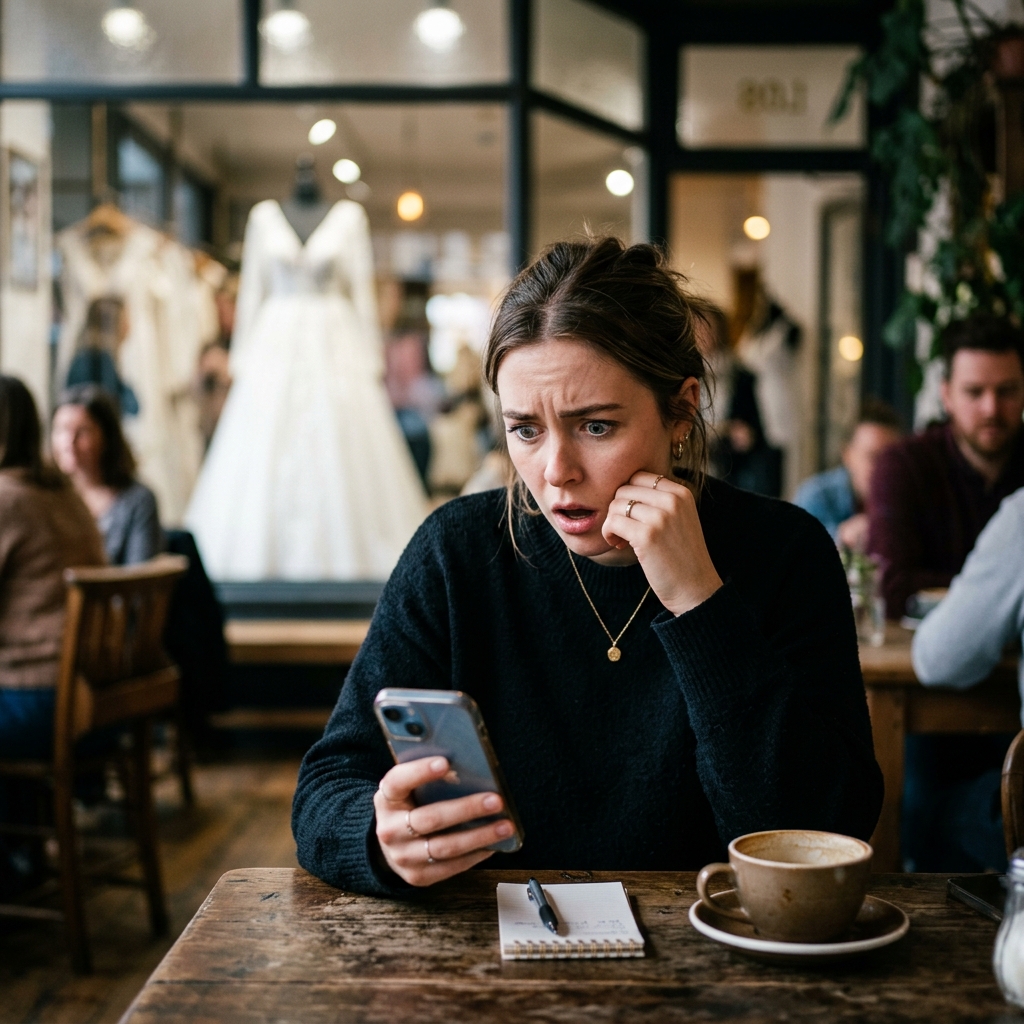
The text came from a number I'd deleted but would have recognized anywhere. It said: "I know I have no right. I'm getting married today. I keep thinking about you. Tell me not to do it."
I sat on the edge of my bed and read it maybe thirty times.
Two years of silence. Two years of absolutely nothing, not even the basic human decency of an explanation. And he surfaces on his wedding day — not with an apology, not with an explanation, but with a job for me. That's what it was. He was outsourcing the biggest decision of his life to the woman he couldn't be bothered to break up with. He wanted me to be his emotional escape hatch, his excuse, his permission slip to run. He wanted me to give him something he could use.
I noticed, sitting there at 7:14 in the morning, that I felt something I hadn't expected: I felt sorry for her. The woman in the white dress who was presumably somewhere getting ready, full of anticipation, completely unaware that the person she was about to marry was texting his ex for permission to flee.
She deserved better than him. She just didn't know it yet.
What I Wrote Back
I drafted a dozen replies. The angry one, which was satisfying to write but would have given him exactly what he wanted: confirmation that I was still wounded, still thinking about him, still there. The cold one, three words, which felt good in theory but still felt like engagement. The long one — God, the long one had chapters. It accounted for every month of silence, every message ignored, every question that never got answered. I wrote it and then I read it and I thought: this is everything I have left to say to a man who has never once, not once, been worthy of the effort.
I deleted all of them.
Here is what I sent, in full: "You ghosted me two years ago. You don't get to haunt me today. Whatever you're feeling belongs to you and the woman in the white dress — go tell her, or go marry her, but leave me out of it. Congratulations either way."
I read it twice. I changed nothing. I hit send.
Then I blocked the number, made coffee, and went to my Saturday spin class, where I rode eleven miles to nowhere feeling lighter with each one.
The Part People Can't Believe
Did he go through with it? I have no idea. That's the part that people can't get past — that I never checked, never asked our two mutual friends who were still in contact with him, never once searched his name or her name or looked for any hint of how the day ended.
They always ask: Don't you want to know?
Here is what I've come to understand. His life stopped being information I needed the day he made me a stranger. The text was a test, of sorts — a test of whether that old door was still unlocked. I proved it wasn't. What he did with the rest of his Saturday is not my chapter. It belongs to him and to whoever is now living through the consequences of who he actually is.
Not knowing is the whole victory. I don't carry his story anymore. I only carry mine.
What I Would Tell You
If you're waiting for closure from someone who vanished: stop waiting. Closure isn't something they send you. It's not a phone call or an apology or an explanation that finally makes sense. It's not a wedding-day text that proves they still think about you. Those things feel like closure because they feel like proof that you mattered. But you don't need their proof.
Closure is something you write yourself. You decide when the story ends. You decide when to stop leaving the door unlocked. You decide when the chapter closes and when the next one begins.
I wrote mine at 7:14 on a Saturday morning, in forty-seven words, with coffee not yet made and the day wide open in front of me.
You can post yours whenever you're ready.