

Some bad days announce themselves. Others just quietly stack up until you find yourself sitting alone in a diner booth at 3 p.m. on a Tuesday, ordering coffee you don't want because you can't face going home to the thing waiting for you there. That was me, on one of the worst days of my life, in a vinyl booth under a flickering light.
I won't lay out the whole day here. It involved a diagnosis, a phone call, and the particular loneliness of receiving hard news when you have no one immediately nearby to hold it with you.
I Didn't Say a Word About It
The waitress was young, busy, working a nearly empty afternoon shift. I ordered coffee and then a sandwich I picked at. I said please and thank you and nothing else. I was not, I thought, giving anything away. I've spent a lifetime being fine on the outside.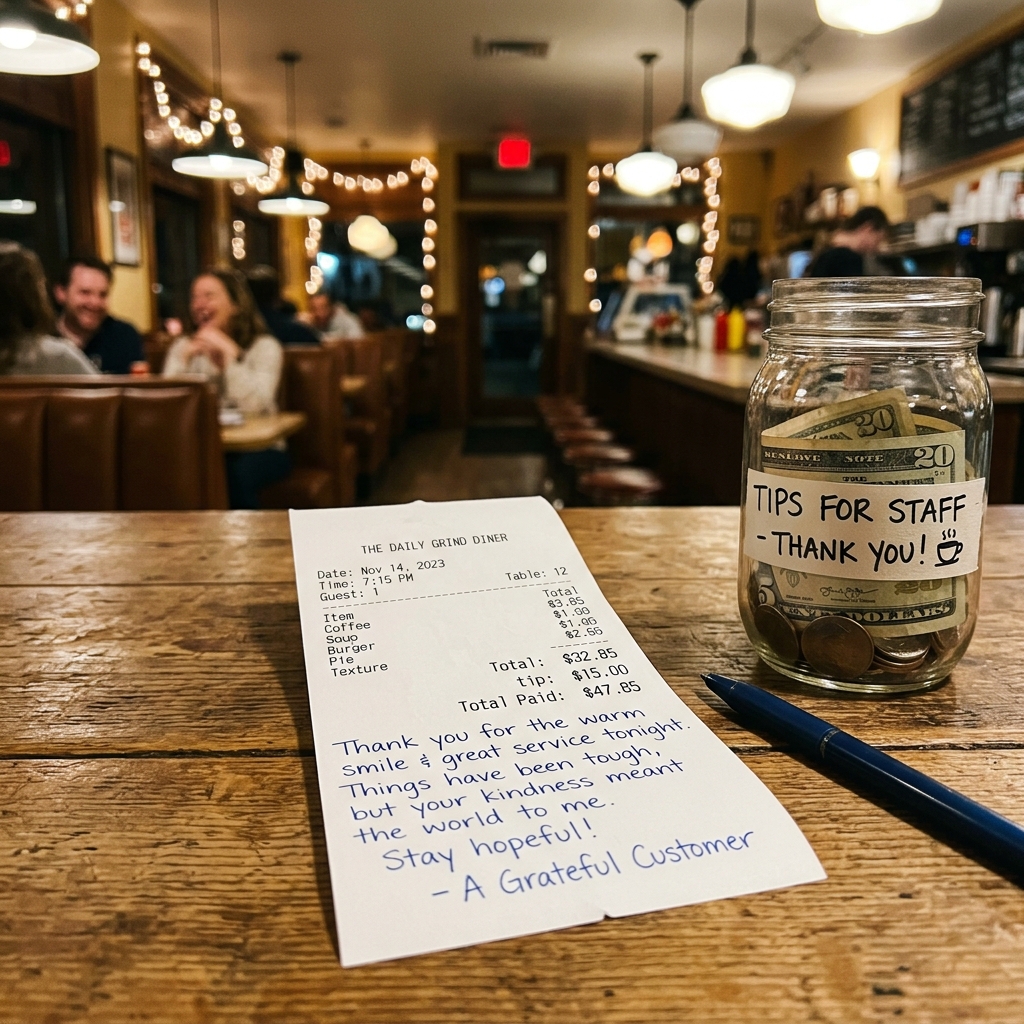
But she kept refilling my cup without being asked, and each time she did, she'd catch my eye for just a second, gently, the way you'd check on someone you actually knew.
Six Words
When she brought the check, I paid, left a tip, and it wasn't until I got to my car that I flipped the receipt over and saw she'd written on the back. Six words, in blue pen: "Whatever it is — you'll get through."
Underneath, she'd drawn a small, slightly lopsided sun.
How Did She Know
I sat in that parking lot and sobbed — the good kind, the kind that finally lets the pressure out. I still don't know how she knew. I hadn't cried inside. I hadn't spoken. But somehow, in the small human data of refilled coffee and a picked-at sandwich and a person alone at 3 p.m., she'd read the truth and decided to do something about it with the only tools she had: a pen and thirty seconds of courage.
She had no way of knowing what my "it" even was. She just knew there was one. And she reached out anyway.
What I Carry Now
I went back the next week to thank her and, honestly, to tip her properly. She barely remembered me — she told me she writes little notes for people who "look like they're carrying something," which apparently is a lot of people, which tells you something hopeful and heartbreaking about how many of us are quietly struggling in vinyl booths.
I keep that receipt in my wallet. Two years later it's soft as cloth from handling. On my own hard days I take it out and read the six words from a stranger who never knew my story and believed in my getting-through anyway. Attention is a form of love. You can hand it to a stranger in the time it takes to write on a receipt. She'll never know what hers did. Do it anyway.


